Gemini: what it is and how to use it correctly to get the most out of it
Gemini is Google's AI platform that processes and generates natural language, simplifying your daily work.
OpenAI arrived first with ChatGPT and shook the world. But Google has spent 25 years building the most powerful search engine in history, has access to more data than anyone else, controls the operating system of 3 billion phones, and has just launched the most ambitious artificial intelligence model it has ever created.
It's called Gemini. And if you're not using it yet, you're probably making decisions with less information than you could have.
Google Gemini is not just another chatbot that answers questions. It's a family of artificial intelligence models, a digital assistant, and at the same time, a technology integrated into services like Android, Gmail, Google Drive, Docs, Maps, YouTube, and other tools in the Google ecosystem.
Gemini is used for conversation, research, writing, summarizing documents, analyzing images, reviewing code, organizing information, and running tasks connected to Google applications. Its main difference from GPT lies not only in which one performs better, but also in how each technology integrates with the tools we use every day.
Gemini belongs to Google. GPT belongs to OpenAI. Gemini is notable for its direct relationship with the Google ecosystem, while GPT is the family of models that powers ChatGPT and various applications created using the OpenAI API.
However, saying that one is always better than the other would be misleading. The right choice depends on what you need to do.
For someone who works constantly with Gmail, Google Drive, Docs, Calendar, Android, or Maps, Gemini can be especially useful. For those looking for a general conversational assistant, advanced scheduling, project creation, file analysis, or custom workflows, ChatGPT can also be a very powerful alternative.
The best way to decide isn't to ask which one scores higher on a single test. What matters is comparing which one best solves your actual task, with fewer corrections, fewer steps, and more reliable results.
What is Gemini?
Gemini is Google's generative artificial intelligence model, multimodal from its basic design. It can process and generate text, images, audio, video, and code in a single conversation, with real-time internet access.
Gemini is the name Google uses to identify a family of generative artificial intelligence models and the products built around them.
This distinction is important because Gemini is not a single application with a single capability. It is a complete artificial intelligence ecosystem.
In its simplest form, Gemini functions as a conversational assistant. You type a question, attach a file, or speak using your voice, and the system generates a response.
In more advanced uses, you can analyze extensive documents, compare information, examine a photograph, interpret code, query connected services, prepare a report, or help automate processes through an API.
Gemini price
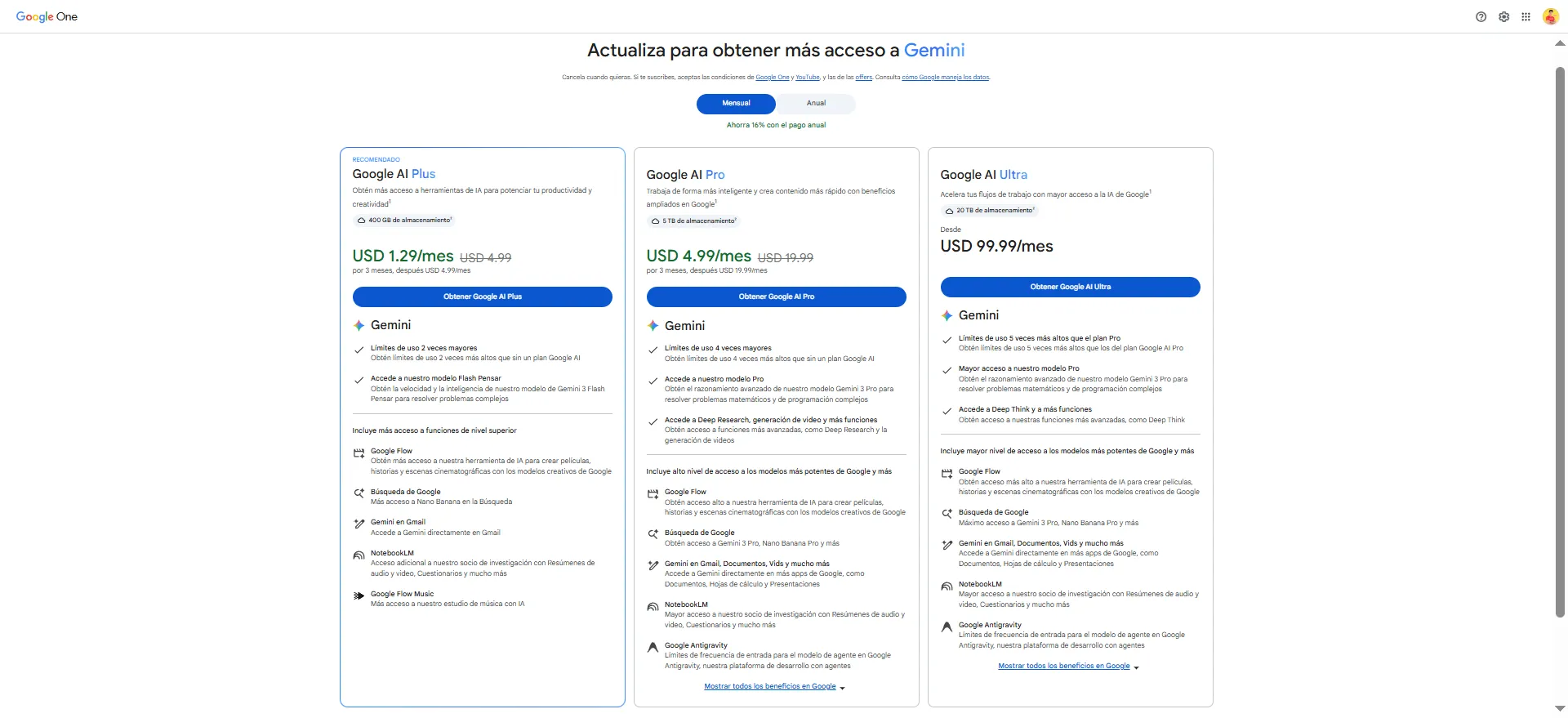
Gemini also has a free plan: access at gemini.google.com with the Gemini 3 Flash model.
- Google AI Plus: 1.29 per month USD.
- Google AI Pro: 4.99 per month USD.
- Google AI Ultra: 99.99 per month USD.
What does generative artificial intelligence mean?
Generative artificial intelligence is a type of technology capable of producing new content from instructions. This content can include:
- Texts.
- Summaries.
- Emails.
- Images.
- Programming code.
- Tables.
- Ideas.
- Plans.
- Explanations.
- Scripts.
- Information.
- Audio or multimedia content, depending on the model used.
The word “generative” doesn’t mean that artificial intelligence thinks exactly like a person. It means it can generate a response by calculating which content is most appropriate based on the request, the available context, and the patterns learned during its training.
For this reason, Gemini can write a convincing explanation and still be wrong. Their ability to write confidently doesn't guarantee that all the facts are true.
Artificial intelligence should be used as a support tool, not as an infallible source.
How Gemini Works
The exact inner workings of Gemini contain proprietary elements that are not publicly available. However, it is possible to understand its general process without delving into overly technical explanations.
When a person types an instruction, Gemini performs several stages. First, it interprets the input. That input can be text, an image, audio, video, a file, or a combination of different formats.
Then it divides the information into units that the model can process. In the case of text, these units are usually called tokens. A token can represent a word, part of a word, a symbol, or a combination of characters.
Next, the model analyzes the relationship between these units. It doesn't just look for exact words. It tries to understand the context, the intent, the requested format, previous instructions, and the data included in the conversation.
Then it calculates a likely response. It does this step by step, generating fragments of content based on learned patterns and received instructions.
In certain cases, Gemini can also use external tools. For example, it can retrieve current information through a search, analyze a file, execute code, use Maps data, or interact with a connected application.
Finally, it presents the result to the user in the form of text, table, code, image, report or action, depending on the function used.
The complete process can be summarized as follows:
- The user sends an instruction.
- Gemini identifies the intention.
- Analyze the available context.
- Decide if you need to use a tool.
- Process the information.
- Generate a response.
- Apply security filters and controls.
- Show the result.
Gemini History
The story of Gemini doesn't begin in 2023. It begins much earlier, in the labs of Google DeepMind and Google Brain, two of the world's most respected AI research centers. For years, Google trained language models like LaMDA and PaLM, but they all had one thing in common: they were internal tools or secondary products, never the main product.
The launch of ChatGPT in November 2022 changed that dramatically. Google, which had dominated search for two decades, suddenly saw a direct threat to its core business. The response was Bard, hastily launched in February 2023, which didn't exactly make the best impression. In its live presentation, Bard made a factual error that cost Google $100 billion in market capitalization in a single day.
But that setback accelerated something that was already underway. In December 2023, Google officially unveiled Gemini 1.0, the model built from the ground up with multimodality as a core feature—not an afterthought. And in 2024 and 2025, the evolution was rapid and decisive.
Update release date
- Dec 2023 → Gemini 1.0 ·
- Feb 2024 → Gemini 1.5 Pro (1M tokens) ·
- Dec 2024 → Gemini 2.0 Flash ·
- Feb 2025 → Gemini 2.5 Pro ·
- 2025 → Gemini 3 Flash as the default model for all users
What makes Gemini different from its predecessors isn't just the power of the model, but the vision behind it: Google didn't want to build a chatbot. It wanted to build a universal assistant that lived within all the products people already use—Gmail, Maps, YouTube, Android, Chrome—and could intelligently act on the user's behalf.
Transformer architecture and the attention mechanism
Gemini is built on the Transformer architecture, which has been the industry standard for AI since 2017. What makes Gemini different is how Google has optimized this architecture to handle huge context windows: up to 1 million tokens in the most advanced versions.
To give you an idea, 1 million tokens is roughly equivalent to a 700-page novel — or 10 hours of audio transcription, or a medium-sized complete code repository.
What is the context window?
It's the amount of information the model can "hold in mind" at the same time during a conversation. The higher the number, the more documents, history, and context it can process before it starts "forgetting" earlier parts. The Gemini 2.5 Pro currently has the largest capacity on the market among consumer models.
Real-time internet access
Unlike models with a knowledge cutoff date, Gemini is connected to Google Search by default. When you ask it a question about something current—a recent event, the price of something, the latest news—it can search in real time and give you an up-to-date answer. This is a huge advantage over versions of ChatGPT that use outdated training data.
Deep Research: Autonomous, multi-step research
One of Gemini's most powerful capabilities in 2025 is Deep Research, available in the Pro plan. It's an agent that can plan complex research, run multiple searches, synthesize more than 20 sources, and deliver a structured report. Tasks that would take 3-4 hours of manual research, Gemini accomplishes in minutes with a synthesis quality superior to most manual searches.
Why is Gemini said to be multimodal?
Gemini is described as a multimodal artificial intelligence because it can work with different types of information.
A text-only system could only interpret written words. A multimodal model can relate text, images, audio, video, documents, and code within the same task.
For example, you can photograph a circuit board and ask it to identify the visible components. You can also attach a document and request a summary, share a screenshot of a programming error, or display a chart for it to explain its data.
Multimodality allows us to ask questions like these:
- Which component appears burned on this board?
- Summarize this PDF and extract the important dates.
- Analyze this photograph and describe the objects.
- Review this screenshot and explain the error to me.
- Compare the information in these two images.
- Convert this data into a table.
- Explain to me what happens in this video.
- Review this repository and locate any potential problems.
The quality of the result will depend on the clarity of the file, the selected model, the context provided, and the complexity of the task.