The 25/50/15/10 Rule: How to Manage Your Money Like the 1%
Learn how to apply the 25/50/15/10 rule to your salary, allocate expenses, save, and invest. Includes examples, calculations, and alternatives if you have debt.

Some people earn $3,000 a month and arrive at payday with their account practically empty. Others receive $1,000, pay their bills, maintain some savings, and manage to gradually move toward their goals.
The difference isn't always about how much money comes in. It also matters how much it costs to maintain that lifestyle, what debts exist, and how each income is allocated.
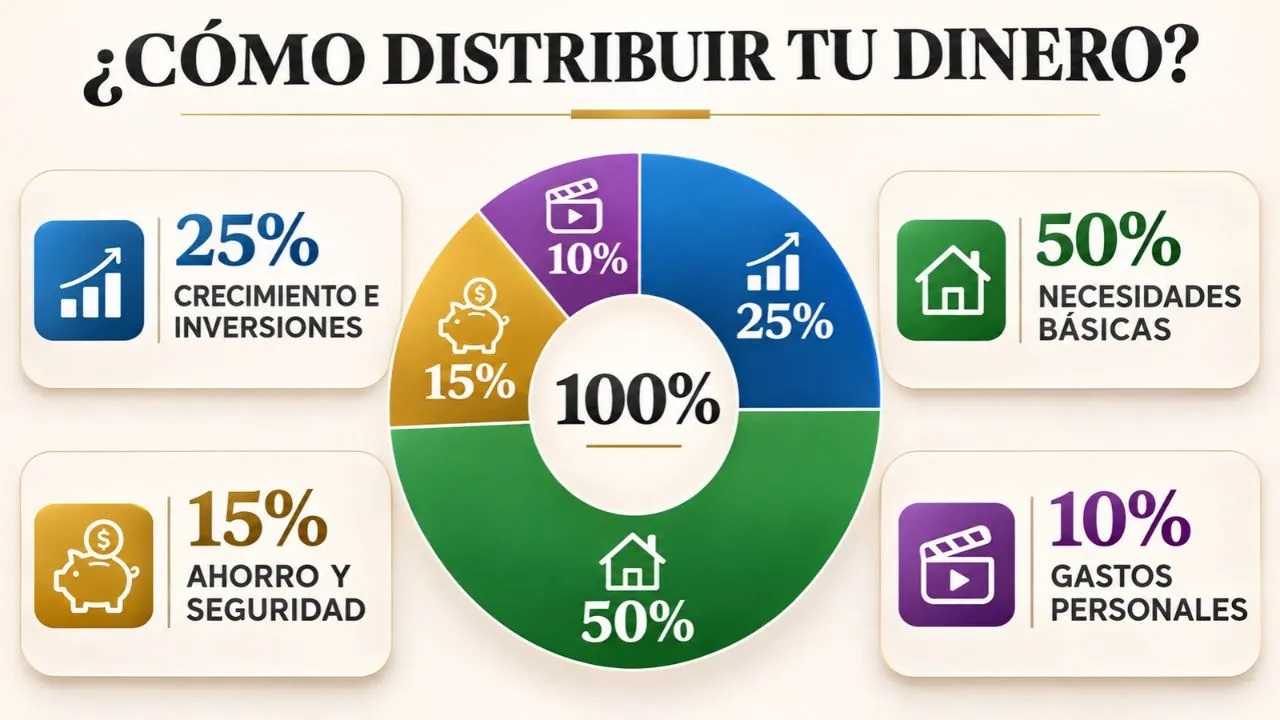
One way to organize these decisions is the 25/50/15/10 rule , a budgeting system that proposes using 25% of income for wealth growth, 50% for essential needs, 15% for financial security, and 10% for personal expenses.
The method has become popular with the idea of managing money like the wealthiest 1%. However, there is insufficient evidence to claim that everyone in that group uses these percentages. Its real value lies in setting priorities and turning them into monthly decisions.
In this guide you will learn how to calculate each amount, recognize when the rule is not viable, adapt it if you have debts, and organize your savings without resorting to promises of quick riches.
What is the 25/50/15/10 rule and how does it work?
The 25/50/15/10 rule is a money management formula that divides net monthly income into four categories with different goals.
It was popularized, among others, by the entrepreneur and financial communicator Mark Tilbury, who uses a distribution focused on growth, stability, needs and rewards.
Their approach is simple: before spending your salary, you decide how much you can use to live, what percentage you need to protect, and how much you are able to allocate to the future.
| Percentage | Category | Purpose |
|---|---|---|
| 25% | Growth and investments | Building long-term wealth |
| 50% | Basic needs | Pay essential expenses |
| 15% | Savings and security | Create a financial reserve |
| 10% | Personal expenses | Enjoy money responsibly |
| 100% | Total | Organize all your income |
The formula is calculated on net income, that is, the money you actually have available after taxes and mandatory deductions.
For example, with a salary of $1,600, the amounts would be $400 for growth, $800 for needs, $240 for savings, and $160 for personal expenses.
There's a crucial detail: the percentages are a guideline, not a requirement . If you need 70% of your salary for housing, food, and transportation, you shouldn't cut essential expenses just to follow the method.
25% for growth: how to start building wealth
The first part of the rule proposes setting aside a quarter of your income to improve your future financial situation.
Unlike money used to pay bills, the goal of this percentage is to acquire assets, develop productive capabilities, or finance projects capable of generating value over time.
Let's say you receive $2,000 net per month. 25% represents $500. If your financial situation is stable, that amount could be allocated to long-term investments that align with your goals and risk tolerance.
But there's a difference between allocating money to an investment and achieving a return. No percentage guarantees positive results.
What can you use that 25% for?
One option is diversified investment funds, which allow you to distribute your capital among different assets. There are also fixed-income instruments, index funds, and retirement savings plans, depending on the country and the available alternatives.
Another possibility is to invest in a productive activity. A freelancer could acquire tools that allow them to provide better services, while a small business could finance an operational upgrade with a reasonable expected return.
Not all business investments generate profits. Buying an expensive computer or paying for advertising without a business plan doesn't automatically make that expense a profitable investment.
Before committing money, it is advisable to evaluate the full cost, risks, fees, time horizon and ease of recovering the capital.
Should you invest 25% even if you have debts?
Not necessarily. This is one of the points where the rule needs more flexibility.
If you have a credit card that charges high interest rates, continuing to invest while the debt increases can harm your finances.
The U.S. Securities and Exchange Commission, through Investor.gov , recommends prioritizing the repayment of high-interest debt before taking on certain investment risks.
A reasonable strategy involves covering minimum needs and payments, creating a small reserve for unforeseen events, and allocating part of the growth budget to reducing the most expensive debts.
Once those obligations are under control, you can gradually increase your investments.
50% for basic needs: find out how much your life really costs
The second part of the rule is dedicated to essential expenses.
This includes housing, basic food, necessary transportation, public services, medical care, essential insurance, and mandatory minimum loan payments.
It's not about keeping those expenses artificially low. It's about knowing how much they cost and determining if they're in a sustainable proportion to your income.
For example, a person earning $1,800 would have an ideal reference budget of $900 for needs.
The problem arises when rent costs $650, food $300, and transportation $150. With those three items alone, he already needs $1,100, not including utilities or other obligations.
In that scenario, insisting on the $900 limit doesn't solve the problem. The distribution needs to be adjusted to reflect actual expenses.
How to distinguish needs from wants
A need is an expense that you must cover in order to maintain adequate living conditions and fulfill your responsibilities.
Food is essential; ordering takeout several times a week is usually a discretionary expense. Needing internet for work can be essential; subscribing to multiple entertainment services isn't necessarily so.
There are also expenses that depend on the context. A car might be essential for someone who works in an area without public transportation and an optional convenience for someone who lives close to their job.
The correct classification doesn't depend solely on the product. It depends on the function it serves in your life and the reasonable alternatives available.
The expense that many people forget to include
Annual expenses should also be included in the budget.
Imagine you pay $240 a year for insurance and $360 for predictable vehicle maintenance. Even though those payments don't happen every month, they add up to $600 annually.
That's equivalent to setting aside $50 per month for future obligations.
If you don't, the month the bill arrives it will seem like you've suffered an emergency, when in reality it was a known expense that you could have planned for.
Save 15%: Build your financial protection
Saving does not serve exactly the same function as investing.
While an investment seeks to generate returns and may lose value, an emergency fund prioritizes security and availability.
Its goal is to allow you to deal with unexpected expenses without immediately relying on a credit card or loan.
According to the U.S. Consumer Financial Protection Bureau , having a specific reserve can help cope with income interruptions, repairs, and other unexpected expenses.
The 15% of the rule is primarily intended to build that protection.
How much money do you need in your emergency fund?
A common guideline is to gather between three and six months of essential expenses, although the appropriate amount depends on each situation.
If you spend $750 per month on essential needs, a three-month reserve is equivalent to $2,250. A six-month reserve would be $4,500.
If you are self-employed, your income is unstable, or several people depend on you financially, you may need a larger reserve.
There is no universal number. The important thing is to assess what amount would allow you to weather a difficult period without taking on unnecessary debt.
How to calculate how long it will take you to achieve it
Imagine you earn $1,500 net per month and your essential expenses are $750.
By allocating 15% to the emergency fund, you would save $225 per month.
| Aim | Amount | Approximate time |
|---|---|---|
| 1 month of expenses | $750 | 4 months |
| 3 months of expenses | $2,250 | 10 months |
| 6 months of expenses | $4,500 | 20 months |
The calculations assume you start with no savings, make regular contributions, and make no withdrawals. They do not include interest.
Once you've reached your savings goal, you can review how you plan to use that 15%. For example, you could allocate some of it to planned future expenses or increase your contributions to long-term goals.
The reserve should be kept easily accessible and separate from the money intended for everyday purchases.
The 10% to enjoy: why a budget also needs flexibility
Many people associate good financial management with completely eliminating outings, travel, or personal purchases.
But a budget that requires giving up any enjoyable expenses can be difficult to maintain.
The last 10% of the rule recognizes that personal activities also have a place within an organized economy.
If you earn $1,500, you would have $150 available for entertainment, experiences, small treats, or non-essential purchases.
You can spend that amount during the month or set aside a portion for a more important activity.
The difference is that you know how much you can use without compromising bills, savings, and existing obligations.
This percentage is also flexible. If you are experiencing financial hardship, it may be necessary to temporarily reduce discretionary spending.
How to apply the 25/50/15/10 rule based on how much you earn
The simplest way to understand the system is to calculate it using concrete quantities.
The following table shows how the distribution would look for different monthly net incomes, expressed in US dollars.
| Monthly income | 25% growth | 50% needs | 15% savings | 10% staff |
|---|---|---|---|---|
| $700 | $175 | $350 | $105 | $70 |
| $1,000 | $250 | $500 | $150 | $100 |
| $1,600 | $400 | $800 | $240 | $160 |
| $2,400 | $600 | $1,200 | $360 | $240 |
| $3,500 | $875 | $1,750 | $525 | $350 |
| $5,000 | $1,250 | $2,500 | $750 | $500 |
The results are mathematical calculations, not quantities that everyone should follow.
Someone earning $700 might need more than $350 to cover their basic expenses. In that case, cutting back on investments and protecting essential needs would be a more sensible decision than applying rigid percentages.
The advantage of this table is that it shows the ideal target. The next step is to compare it with reality.
A complete example: how to organize $2,000 monthly

Imagine a person who receives $2,000 net, has no expensive debts, and wants to organize their finances.
His actual needs amount to $1,000 per month, so he can apply the rule without neglecting his obligations.
The budget would be as follows:
| Category | Monthly budget | Annual contribution |
|---|---|---|
| Growth and investments | $500 | $6,000 |
| Essential needs | $1,000 | $12,000 |
| Security fund | $300 | $3,600 |
| Personal expenses | $200 | $2,400 |
| Total | $2,000 | $24,000 |
In twelve months he would have allocated $6,000 to investments and contributed another $3,600 to his financial reserve.
This represents $9,600 allocated to asset and security objectives.
It doesn't mean you've earned $9,600. Investments can increase or decrease in value, while savings represent money set aside, not a return.
The important thing is that a significant portion of the income has been deliberately allocated to future goals instead of disappearing into unplanned expenses.
How much could your money grow if you invest every month?
One of the main attractions of long-term investing is the possibility of obtaining returns on previously accumulated amounts.
This process is known as compound growth.
Imagine you invest $250 monthly for twenty years and we use a hypothetical constant return of 5% nominal annual, compounded monthly.
The approximate result would be:
| Term | Total contributed | Hypothetical final value |
|---|---|---|
| 10 years | $30,000 | $38,821 |
| 20 years | $60,000 | $102,758 |
In the twenty-year scenario, you would have contributed $60,000 of your own money. The difference up to the final value would correspond to the growth calculated under those assumptions.
This is not a prediction or a guaranteed return. The calculation does not include fees, taxes, or inflation. Furthermore, markets do not generate consistent returns every month and may result in losses.
The figure would also be different if you increase or decrease your contributions, change investments, or need to withdraw money.
What the exercise demonstrates is the mathematical effect that regular contributions and time can have, not that any investment will produce those results.
To reduce unnecessary risk, understanding diversification is crucial. Investor.gov explains how to allocate investments based on your goals, time horizon, and risk tolerance.
What happens if you earn little and can't follow the rule?
This is probably the most important question in the entire guide.
The rule assumes that a person can cover their basic expenses using only half of their income and set aside another 40% for growth and security.
However, that scenario is not always realistic.
Let's consider someone who receives $950 net per month and needs $665 for food, housing, utilities, and transportation.
Their needs represent 70% of their income. The budget available after covering those needs is $285.
Trying to invest 25% of your salary and save another 15% would consume $380, an amount greater than the money actually available before considering personal expenses.
The original rule, in this case, does not work.
An adaptation for tight budgets
The person could start with an alternative distribution:
| Category | Original rule | Adapted example |
|---|---|---|
| Growth | 25% | 5% |
| Needs | 50% | 70% |
| Saving | 15% | 15% |
| Staff | 10% | 10% |
With $950 per month, this adaptation would allocate $47.50 to growth, $665 to needs, $142.50 to savings, and $95 to personal expenses.
Even this version might require modifications. If you have expensive debts or a precarious financial situation, it might be wise to prioritize a minimum reserve and outstanding payments before investing.
The goal is not to meet a percentage out of pride, but to have a sustainable budget.
Three steps to improve your finances
First stage: stability. Cover essential needs, avoid delays, record expenses, and start a small emergency reserve.
Second stage: recovery. Reduce costly debts, strengthen your emergency fund, and aim to improve your available money at the end of each month.
Third stage: growth. When there is greater stability, progressively increase the contributions allocated to investments and long-term goals.
You don't have to go from saving nothing to investing 25% immediately. Sustainable habits are often more useful than goals you abandon after two months.
How to manage money if you are self-employed?
Budgeting can be more complicated for those who work as freelancers, tradespeople, independent professionals, or small business owners.
An employee with a fixed salary knows approximately how much they will receive each month. A person who depends on sales, projects, or commissions may experience significant fluctuations.
The first mistake to avoid is confusing billing with disposable personal income.
If your business bills $3,000, but needs $1,000 for operations and another $400 for tax obligations, you shouldn't use the full $3,000 as the basis of your family budget.
In this simplified example, $1,600 would remain before considering any other outstanding obligations or adjustments.
How to adapt the rule to variable income
Start by reviewing your net income for the last six to twelve months.
You can use Lobito Isaias's average calculator to obtain an arithmetic mean of several amounts, entering each income as a value with the same weight.
However, the average doesn't always represent a guaranteed monthly income. If there are exceptionally high months and low months, it's best to base your budget on a conservative amount that you can sustain.
It's also helpful to keep business and personal accounts separate. That way, operating expenses aren't mixed up with money earmarked for housing, food, or family savings.
When you receive extra income, you can use it to strengthen your savings, reduce debt, or move closer to long-term goals.
How to increase your income so the rule is easier to follow
There's a limit to cutting costs. Below a certain amount, further reductions can affect essential needs.
Increasing your income can also help you improve your budget, especially when you're already managing your income responsibly.
Imagine that your essential expenses remain at $900 per month.
If you earn $1,200, those needs represent 75% of your income. But if you manage to raise your net income to $1,800 without increasing those expenses, they drop to 50%.
That difference significantly changes your ability to save and invest.
One possibility is to develop a side hustle. In this guide, you'll find 20 jobs to generate income from home , with options such as virtual assistance, writing, programming, design, and digital services.
If you already have a business, you can also focus on improving sales of existing products or services.
For example, learning how to advertise your business on Google Maps to get more customers can be useful for local businesses that need to expand their business reach.
However, any advertising campaign must be evaluated based on its cost and the revenue it actually generates. Spending more on ads does not guarantee earning more money.
The most favorable combination is to improve disposable income while keeping obligations under control and avoiding automatically increasing all expenses.
Rule 25/50/15/10 versus Rule 50/30/20
Another well-known method for organizing finances is the 50/30/20 rule.
Its distribution consists of using 50% of income for needs, 30% for wants, and 20% for savings, investments, or specific financial goals.
The 25/50/15/10 rule proposes a larger proportion earmarked for the future, but leaves less room for discretionary spending.
| Aspect | Rule 25/50/15/10 | Rule 50/30/20 |
|---|---|---|
| Needs | 50% | 50% |
| Savings and investment | 40% combined | 20% |
| Personal expenses | 10% | 30% |
| Main advantage | Greater potential storage capacity | Greater consumption flexibility |
| Main difficulty | It requires considerable financial margin. | You can allocate less to wealth goals |
Neither method is universally superior.
The 50/30/20 rule can offer a more comfortable starting point if your finances are balanced, but you need more flexibility in personal spending.
The 25/50/15/10 can serve as an ambitious goal when your income allows you to set aside a high proportion without neglecting obligations.
And if none of these suit your budget, you can use a personalized or zero-based budget, in which you assign a purpose to each available amount according to your actual priorities.
Mistakes that can cause the 25/50/15/10 rule to fail
Investing while accumulating costly debt
Buying financial assets while paying high interest rates can worsen your financial situation.
Before investing aggressively, review how much your loans cost you and consider reducing the most expensive debts.
Confusing an emergency fund with an investment fund
Emergency funds need to be readily available and secure. They shouldn't rely on selling volatile assets at an unfavorable time.
A reserve doesn't serve its purpose if you lose access to the money precisely when you need it.
Forget about annual expenses
Insurance, maintenance, and other recurring obligations can throw your budget off balance if you don't set aside an amount each month.
The fact that a bill arrives once a year does not mean it is impossible to plan for it.
Improve your lifestyle with each salary increase
If your salary increases by $300, but you immediately acquire new obligations for that same amount, your financial margin does not improve.
An alternative is to decide in advance what part of the increase you will allocate to security, goals, and consumption.
Applying percentages without checking your results
A budget is not a document that you prepare once and forget about.
Your income, responsibilities, and expenses change. Reviewing them regularly allows you to correct problems before they turn into debt.
30-day plan to organize your finances with this rule
You don't need to transform your entire finances immediately. You can use the next month to build a system that works for your circumstances.
First week: find out how much money you have available
Gather your net income and review your account transactions from the last few months.
Identify essential expenses, financial obligations, discretionary purchases, and recurring payments that you usually forget.
At the end, you should know how much it costs to maintain your lifestyle each month and how much is left available for other goals.
Second week: design a realistic budget
Calculate what the four percentages would represent with your current income.
Then compare them with your actual expenses.
If the distribution proves viable, you can test it. If not, create a scaled-down version that prioritizes financial stability.
At this stage it is also advisable to set a specific initial savings goal.
Third week: organize accounts and automate
Separate your money for needs, savings, and discretionary spending using accounts, sub-accounts, or another system you can manage.
If you have a stable income, consider automating a transfer to savings after you receive your salary.
Before setting up automatic transactions, make sure you maintain sufficient funds to cover your obligations and avoid overdraft fees.
Week four: Check what worked
At the end of the month, compare the budgeted amounts with the actual expenses.
If a category exceeded the limit, identify the cause. An impulse purchase is not the same as an essential medical expense.
Then determine which adjustment you can keep the following month.
The goal of the first 30 days isn't to achieve perfection. It's to stop making financial decisions without understanding their impact on your other obligations.
Frequently asked questions about the 25/50/15/10 rule
Who created the 25/50/15/10 rule?
Mark Tilbury is one of the popularizers who helped popularize this income distribution method in his content on money management. It's not an official rule, and there's no evidence that a single person created all its variations.
Does the 25/50/15/10 rule work to become a millionaire?
It doesn't guarantee becoming a millionaire. It can help develop saving and investment habits, but the results depend on each person's income, time, returns, risks, and financial decisions.
How much should I invest if I earn $1,000 per month?
The original formula suggests $250 for growth, $500 for needs, $150 for savings, and $100 for personal expenses. However, you should only follow it if your obligations and financial situation allow for that allocation.
What do I do if my expenses exceed 50% of my income?
First, calculate how much you truly need to cover your basic needs. Then, adjust other categories, review expenses you can reduce, and consider ways to increase your income. Don't neglect housing, food, or healthcare just to meet the minimum requirements.
Is it better to save or invest first?
It depends on your obligations and debts. It's generally wise to have an initial reserve for unexpected expenses and to pay off expensive debts before taking on significant investment risks. Saving and investing serve different purposes.
What is the difference between the 25/50/15/10 rule and the 25/15/50/10 rule?
In the version popularized by Mark Tilbury, both expressions can refer to the same distribution: 25% for growth, 15% for stability, 50% for needs, and 10% for rewards. However, there are adaptations with different categories; always check how each author defines the percentages.
Can I apply this rule if I am self-employed or a freelancer?
Yes, but you should first calculate your actual disposable income after taxes and business expenses. If your income fluctuates, it's best to work with a conservative estimate and maintain an adequate reserve.
When should I change the percentages?
When your income, essential expenses, family responsibilities, debts, or financial goals change, the system should help you make better decisions, not become an obligation that worsens your stability.
Conclusion: Managing your money better starts with understanding your priorities
The 25/50/15/10 rule has an important lesson: not all the money you receive should automatically be converted into consumption.
Part of it needs to cover your current obligations. Another part can protect you against unforeseen events. And when your situation allows, you can also set aside money to build long-term wealth.
That doesn't mean you should feel obligated to invest a quarter of your salary. For some people, that will be an achievable goal; for others, a different allocation will be much more sensible.
Before you try to manage your money like the wealthiest 1%, try to understand three numbers: how much you receive, how much you need to live on, and how much you can sustainably save.
From there you can make better-informed decisions, reduce errors, and move towards a more stable economy.
Financial progress doesn't begin when you land an extraordinary salary. It begins when you understand your numbers and use that information to decide what to do with them.
Financial disclaimer: This content is for educational purposes only and does not constitute personalized investment advice. The returns used are hypothetical. All investments involve risk, including the potential loss of principal.
About the author: Lobito Isaias publishes content about finance, technology, and digital strategies. This article presents educational information and illustrative calculations; it is not a substitute for professional financial advice.